What happens to someone’s language skills after a stroke? How do they get their languages back? Aphasia, or in other words, the loss of language(s) due to a lesion in the brain, is not a widely known phenomenon.
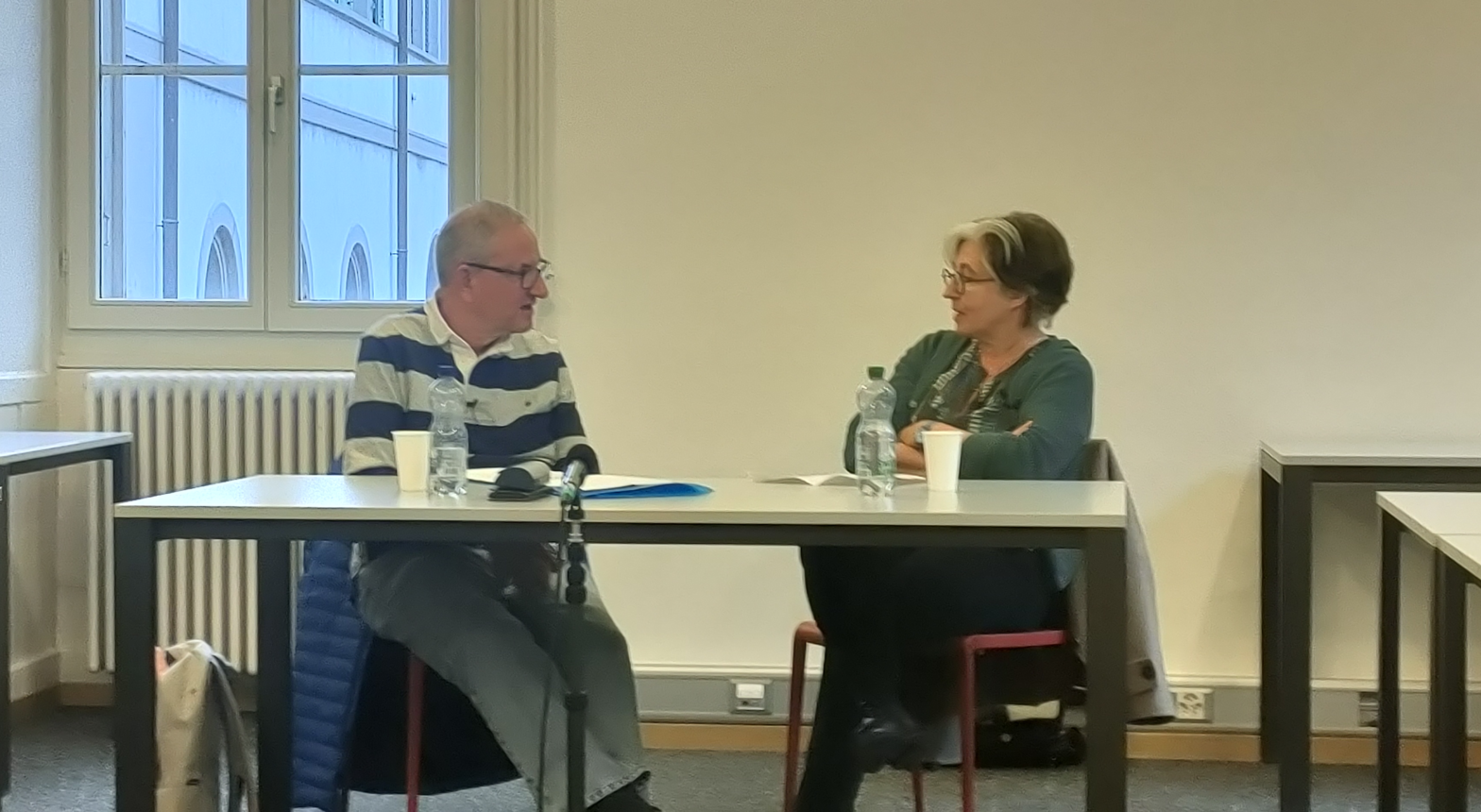
In the podcast, Jürg Schwyter (formerly UNIL, now a private scholar) and Marina Laganaro (Université de Genève) present what aphasia is in a clear and lively way and what it means to patients, therapists and researchers – especially when patients are multilingual.
A dialog of the RING 2025-26
Podcast
To jump from one chapter to the next
point to the podcast and click on « Chapters ».
- Introduction | Giulia Berchio
- What is aphasia? Definition, causes, incidence on speech | Marina Laganaro
- Aphasia in the world | Marina Laganaro
- Tale of a stroke | Jürg Schwyter
- What he knew about aphasia | Jürg Schwyter
- What is known among the population – or among practitioners | Marina Laganaro
- Implications of lack of knowledge in everyday life | Jürgen Schwyter
- Multilingual aphasia: How are different languages affected by a left hemisphere stroke? | Marina Laganaro
- Various patterns of recovery of several languages | Marina Laganaro
- Recovering several languages: a matter of choice and of therapy | Jürg Schwyter
- Pitfalls for the therapist of multilingual speakers | Marina Laganaro
- Strategies to deal with speech difficulties | Jürg Schwyter
- Conclusion
Insights into the discussion with the audience
A multidisciplinary audience asked the guests questions that reflect their different points of view: speech therapists, (applied) linguists, neurologists, foreign language teachers for hospital staff – and interested members of the public.
Aphasia and the brain
What do we know about aphasia and regaining languages? Marina Laganaro made it clear that knowing the physical causes of aphasia still leaves many questions open as to the organisation of languages in the brain or the neurological processes underlying recovery: “When there is aphasia, there is a lesion in the brain. Except in the first weeks, this lesion doesn’t recover. So, there must be other brain regions that allow the patient to recover. Those are mainly what we call “perilesional regions”: around the region where the lesion occurred. Right hemisphere regions may also play a role in the recovery process, but it’s still debated today if it really helps or if it hinders recovery“. She also emphasizes the fact that each patient is unique and presents a sort of aphasia which is caused by lesions in varying regions of the brain and thus leading to different impairments.
. Each patient is unique.
Marina Laganaro
In Jürg Schwyter’s case, declarative knowledge was impaired (the words for naming things were gone or were not accessible) but not the linguistic knowledge: his profound knowledge about languages, such as their phonological system, their (regular) grammar, etc. never was forgotten: “I remember everything from before the stroke. After the stroke, you had to tell me three, four, five, ten times maybe, so I was able to remember – for example with computers. I was never really good with computers. But after the stroke, I drove the secretary [of the English department] absolutely mad […]. The knowledge of language was there before the stroke, and I still can draw from it. But not the latest stuff.”
Marina Laganaro has also studied the question: “It’s a bit controversial but several papers point to the fact that procedural processes, that is knowing and applying rules such as morphosyntactic rules, are not impaired by the same lesions as, for instance, irregular syntax, which has more to do with declarative memory. It makes a difference if the lesion is in a frontal region or a more temporal region”.
Finding words again in several languages
Jürg Schwyter speaks English and Swiss German, in the same varieties as before, English English (as opposed to Australian or American English) and Swiss German. The two languages have cognates (for instance CH-DE: Finger, Huus / EN: Finger, house) and some similar grammatical structures (CH-DE: (be)-schte / EN: (be)-st). This raises questions on the possibility of transfers from one language to the other. As Marina Laganaro explained, there are studies on how rehabilitation effects in one language transfer to other languages. For instance, cognates typically do transfer to the other language, if there is the similar word form in both languages (e.g. Finger in English and German). With therapy working at the lexical level on cognates, there is a high probability that those words will be easier to find and to be produced in the other language. Transfers of reading strategies have also been observed across languages with similar written systems. But all that is specific to the language, vocabulary or grammar, cannot transfer to the other language: it has to be learned anew.
Cognates typically do transfer to the other language.
Marina Laganaro
This does not mean that languages learned anew are separated in the brain. Jürg finds code-switching a helpful resource, that evolves with his ability to continuously regain more words: “Initially, I code-switched all the time. Now it’s just when I don’t find a word, but [the code-switching] has much decreased [over the 17 years since the stroke], and it’s much more compartmentalized now”.
The challenge for multilingual patients remains to find a therapist with appropriate language skills. For Marina Laganaro, even a therapist without native competence in the relevant language can start language therapy in the early acute and post-acute stages. But as the patient recovers a certain level of language competence, a therapist fully proficient in the respective language is preferable.
In the rehabilitation clinic in Valens/SG (cf. podcast), Jürg Schwyter’s speech therapist was bilingual with native competence in Swiss German and English. After his stationary rehabilitation in Valens, the Centre Hospitalier Universitaire Vaudois (CHUV) in Jürg’s hometown, organised a speech therapist who was a native speaker of English English, the very variety Jürg wanted to speak, but she was located in Geneva: more travelling for Jürg, but a perfect match.
This was absolutely crystal clear for me that, when the rehabilitation was over, I would go back to university and teach English.
Jürg Schwyter
But how to choose how many languages and which languages to (re)learn or recover? For Jürg, the choice was easily made: “I wanted to learn English. This was absolutely crystal clear for me that, when the rehabilitation was over, I would go back to university and teach English”. But does motivation play the same role in language learning with or without aphasia? “I think that motivation is quite important, says Jürg Schwyter, and I really had an integrative motivation: I wanted to learn English, speak English and communicate in English again. And there’s another factor: it was the language which I spoke most frequently at the time of the stroke […] It is well known that motivation helps learning. But even if you are very motivated for reacquiring one language, some processes of this language may not be reacquired or recovered for neurophysiological reasons. That is a burden.”
(Re)learning languages
Many studies compared the impact of focused speech and language therapy by professionals to naturalistic conditions, that is, regaining language through exposure and practice. But as Marina explains, people recovering from aphasia need to be guided by experts who can offer treatment and exercises designed to work on very individual impairments in this special form of language learning. “Of course, exposure, practicing is important, but it’s not enough. Even the current studies and all the meta-analyses show that you need at least four to five hours of speech therapy a week for progress to really show up”.
Regaining languages after a stroke is a long – if not silent – process. “In the acute phase, says Jürg, I didn’t talk. I couldn’t talk. I was mute like a fish. In the post-acute phase, I started to talk, but very early on, it was basically incomprehensible. And in the five months which I spent in Valens, I made enormous progress. After these five months, I was in speech therapy in Geneva. And I would say, certainly for the time that the health insurance paid for the speech therapy, that was up to four and a half years, the progress was pretty steep. Not so steep as initially in Valens, but still. Now, the curve has flattened out. But I would say that I’m still making progress, even after 17 years. And this has a lot to do with Dragon [a speech processing software] – I dictate every day with Dragon – and with the physical exercises I do”.
The word is like a bulb that is there. But the electricity is not getting there because it’s somehow interrupted.
Marina Laganaro
Regaining languages? Learning or re-learning languages?
Marina laughs: “Friends, there are entire conferences of researchers that study the issue”. She explains: “What is learning and what is relearning in case of brain damage? I will only be able to give a very partial answer. Recovery following a brain damage is a learning process, whether learning or relearning because some language representations or processes are no longer there and because some brain regions are affected by stroke. This means that some neurological tissue is dead and it’s a learning process because you need to act on plasticity. Plasticity is the fact that other brain regions or connections have to learn doing the job that was done by the region that is affected by the stroke, for instance. So, it’s a real learning.
Now the question is: To what extent is it a relearning? This learning is based on knowledge that may be not completely absent because of the stroke: it is somewhere there, or it is just not connected enough to show up. In this case, I would say it is re-learning: you are just recreating or improving connections for processes that are there but that are disconnected.” As a simple way to imagine what it is like for patients with difficulties finding words, she says: “The word is like a bulb that is there. But the electricity is not getting there because it’s somehow interrupted.”
The CeDiLE thanks Marina Laganaro and Jürg Schwyter for answering the many questions from the audience.
References and links
More about the topic for lay people on Jürg Schwyter’s website.
Reading tips from Marina Laganaro and Jürg Schwyter
Gitterman, M. R., Goral, M., & Obler, L. K. (Eds.). (2012). Aspects of Multilingual Aphasia. Channel View Publications. https://doi.org/10.2307/jj.27195456
Goral, M., & Hejazi, Z. (2021). Aphasia in Multilingual Patients. Current Neurology and Neuroscience Reports, 21(11), 60. https://doi.org/10.1007/s11910-021-01148-5
Paradis, M. (2008). Language and Communication Disorders in Multilinguals. In Handbook of the Neuroscience of Language (pp. 341–349). Elsevier. https://doi.org/10.1016/B978-008045352-1.00033-1
Peñaloza, C., & Kiran, S. (2019). Recovery and Rehabilitation Patterns in Bilingual and Multilingual Aphasia. In J. W. Schwieter & M. Paradis (Eds.), The Handbook of the Neuroscience of Multilingualism (1st ed., pp. 553–571). Wiley. https://doi.org/10.1002/9781119387725.ch27
Pert, S., & Bradley, B. (2018, May). Clinical Guidelines for Speech and Language Therapists: Bilingualism: Working with bilingual clients/patients with speech, language and communication needs. Royal College of Speech and Language Therapists. https://www.rcslt.org/clinical_resources/bilingualism/bilingualism_overview
About the conversation participants
Jürg Schwyter
17 years ago, when he was Professor for English Linguistics in the University of Lausanne, Jürg Schwyter had a severe stroke. Speech therapies helped him regain English and Swiss German and resume his work. Today, a private scholar, he researches aphasia and the interrelationship of multilingualism and strokes – and practises every day – with the help of a Dragon (see podcast).
Marina Laganaro
Professeure ordinaire en neuro-psycho-linguistique à l’Université de Genève, Marina Laganaro mène des recherches sur l’aphasie et les troubles moteurs de la parole des adultes ayant subi un accident vasculaire cérébral (AVC). Elle travaille avec des approches psycholinguistiques, neuropsychologiques et électrophysiologiques et dans des équipes interdisciplinaires. Ce qui ne l’empêche pas d’en parler de façon parfaitement compréhensible !
A summary by the CeDiLE
Redaction CeDiLE: Laura Loder Büchel
Audio, edition: Luminophone
Photo: Anne-Laurence Janin
RING 2025-26 – Ringveranstaltung 2025-26 des Instituts für Mehrsprachigkeit
Limes [‘li:mes] – Grenzen und Grenzüberschreitungen beim Sprachenlernen
Entdecken Sie wieder das Interview mit Emile Jenny zur Mehrsprachigkeit:
